
In HR departments at major Australian companies in Sydney, Melbourne, and Brisbane, a pattern has quietly emerged over the past decade — one that rarely appears in official ABS statistics. Immigrants who built their careers in a new country often had no safety net: no established network, no unspoken insider rules, no assumption that loyalty would be rewarded with pay rises (salary increases). That forced necessity pushed many of them to master salary negotiation from scratch. What they developed turned out to be a repeatable, teachable system — and it's now being adopted by Australian professionals of every background.
The insight here isn't about where someone is from — it's about what happens when a professional is forced to operate without a safety net. Navigating an unfamiliar system without inherited advantages accelerates a specific kind of learning: how to articulate your value in numbers, read a room before making your case, and turn an uncomfortable conversation into a professional outcome. The critical finding: this skill set is not hardwired. It is learnable, adaptable, and can be systematically built through targeted practice.
⚠ Affiliate Disclosure
Harbour Careers is an independent publisher and promotional media site. We are not the official website, manufacturer, or representative of any coaching service. The strategy session featured on this page is a third-party partner offer. We may earn a referral fee when you book through links on this site — this does not affect the price for you. Content is for informational and promotional purposes only. Full Affiliate Disclosure →
The Tall Poppy Syndrome: Why Most Australian Professionals Never Ask
Career researchers point to a uniquely Australian phenomenon: "Tall Poppy Syndrome" — the cultural tendency to cut down those who stand out or ask for more. It is deeply embedded in Australian professional culture and actively discourages salary negotiation. According to workforce surveys including those published by the AHRI (Australian HR Institute), the majority of Australian professionals have never actively negotiated a salary increase with their current employer — a finding consistent with Harbour Careers' own editorial research. The common thread isn't industry or seniority: it's a professional culture that treats self-advocacy as arrogance, and negotiation as something that invites social punishment rather than professional respect.
Most Australian professionals were taught to perform well and wait. The implicit social contract — deliver results, demonstrate loyalty, receive fair reward — persists long after the economic conditions that sustained it have changed. In the post-pandemic labour market, with real wage growth trailing inflation across Australian regions, this assumption has become increasingly costly. The Negotiation Readiness Gap is not a character flaw. It is the product of a professional culture that left negotiation entirely off the curriculum.
“Those who see salary negotiation as an awkward social imposition have already lost. Those who see it as a professional conversation about documented value consistently succeed.
— Harbour Careers Research Team, 2025
Negotiation Agility: How Necessity Becomes a Transferable Skill
What Harbour Careers' editorial analysis of career trajectories across Australian labour markets reveals is striking: professionals who were required by circumstance to navigate structurally unfamiliar environments — whether arriving in Australia from another country, making a radical industry change, or entering a field without conventional credentials — frequently develop the communicative adaptability that negotiation researchers call "Negotiation Agility."
This competency describes the ability to read conversations flexibly, articulate market value with precision, and accept the natural tension of a negotiation as professional dialogue — rather than as a social imposition. It is the product of Adaptive Resilience: a form of experience-based intelligence that can be systematically built in any professional context, regardless of background or starting point.
The crucial point: this agility is not an innate trait. It is not the product of a particular cultural background or personality type. It is a structured, learnable skill — and that is the real message behind the data.
Data Infographic
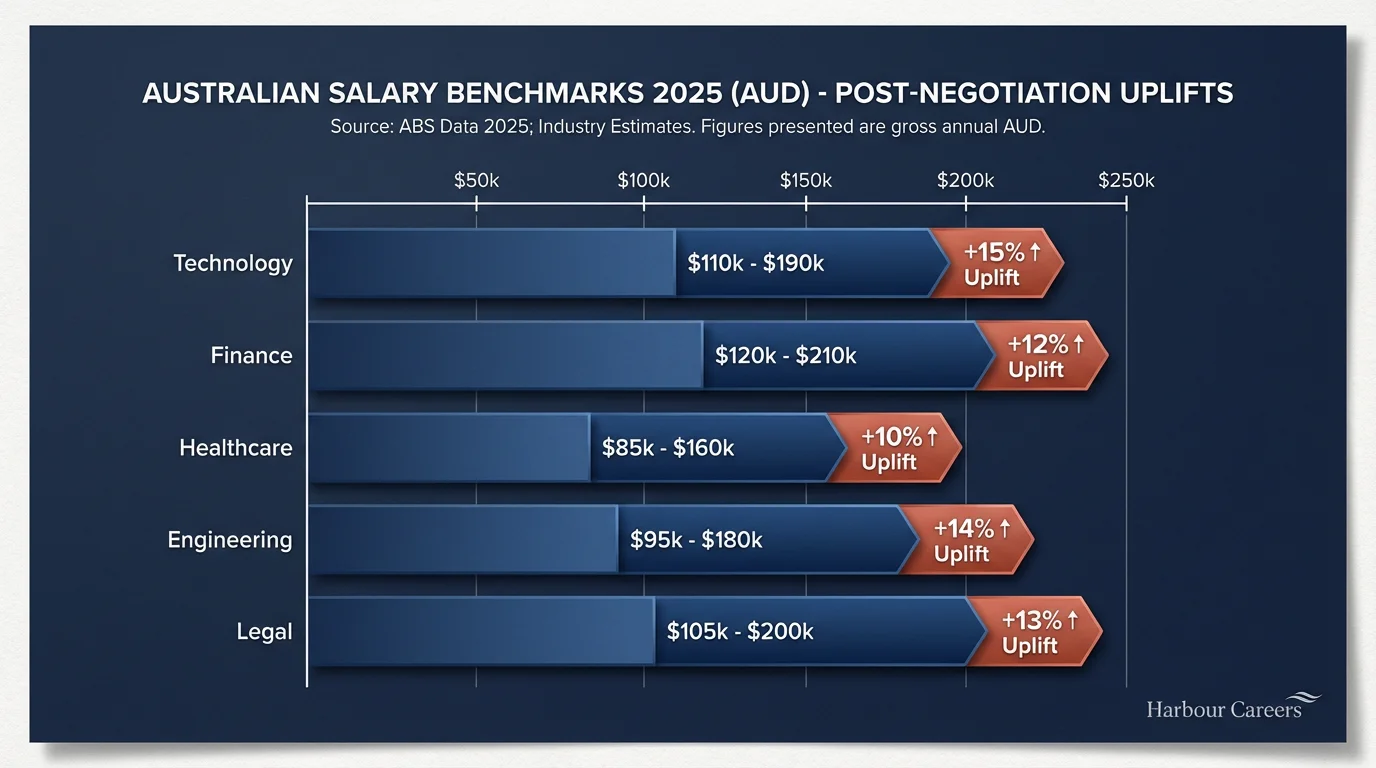
Fig. 1: Salary outcomes by negotiation behaviour — Harbour Careers editorial analysis, 2025. Figures are illustrative based on publicly available ABS data.
The Solution: Formal Education in Negotiation Skills
The good news for those held back by Australia's Tall Poppy Syndrome: the gap is closable — and faster than most expect. What immigrants acquired through forced necessity can be systematically taught through structured training. Modern salary negotiation programmes work across three core competency areas.